












Fiber Optic Tech
Why Optical Isolators Are Essential for 400G and 800G Optical Modules
The rapid expansion of AI computing, cloud infrastructure, hyperscale data centers, and large-scale language model training clusters is driving unprecedented demand for high-speed optical communication. As networks transition from 100G to 400G and now 800G architectures, optical module performance requirements have become extremely stringent. Among the many critical optical components inside these high-speed modules, optical isolators play a fundamental and often under-appreciated role in maintaining laser stability, suppressing noise, and ensuring reliable high-speed signal transmission.
The Rise of 400G and 800G Optical Networks
Modern data centers and AI clusters require massive data throughput, ultra-low latency, and high energy efficiency. This demand has accelerated the widespread adoption of:
· 400G Ethernet optical modules (QSFP-DD, OSFP)
· 800G optical modules (OSFP, QSFP-DD800)
· Coherent optical systems for longer-reach applications
· High-density fiber interconnects and switch fabrics
These technologies deliver enormous bandwidth, but they also make systems far more sensitive to optical interference. At multi-hundred-gigabit speeds, even tiny reflections that were tolerable at 100G can now cause significant performance degradation. Optical isolators have therefore become a critical enabling technology for stable operation at these elevated data rates.
Challenges in High-Speed Optical Transmission
Compared with previous generations, 400G and 800G systems operate under much harsher conditions:
· Higher symbol rates and complex modulation formats (e.g., PAM4 at 100–200 GBaud)
· Higher optical power density inside compact modules
· Tighter link budgets and lower tolerance for noise
· Increased thermal and mechanical stress in densely packed racks
· More complex modulation schemes requiring narrow laser linewidth and low phase noise
Under these conditions, back reflections become a major performance limiter. Reflected light returning to the laser cavity can induce coherent feedback, leading to:
· Wavelength drift and mode hopping
· Elevated relative intensity noise (RIN) and phase noise
· Output power instability
· Signal distortion and eye closure
· Increased bit error rates (BER) and packet loss
· Reduced achievable transmission distance
Without effective isolation, these issues can make it impossible to meet the stringent IEEE and MSA specifications for 400G/800G modules.
How Optical Isolators Protect Laser Performance
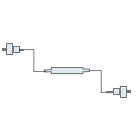
An optical isolator is a non-reciprocal passive device that permits light to pass efficiently in the forward direction while strongly attenuating light traveling backward. It effectively acts as an “optical diode.”
By blocking back reflections before they re-enter the laser cavity, optical isolators deliver multiple critical benefits:
· Stabilize laser emission — Preventing mode competition and wavelength shifts
· Minimize optical feedback — Maintaining narrow linewidth and low noise
· Improve signal quality — Enabling clean PAM4 eye diagrams and stable coherent modulation
· Protect sensitive optical components — Including lasers, modulators, and amplifiers
· Enhance long-term module reliability — Reducing accelerated aging caused by feedback-induced stress
In practice, a well-designed isolator placed immediately after the laser (or integrated in the optical sub-assembly) can reduce back reflections to below -50 dB or even -60 dB, providing the stable operating environment required for today’s high-speed lasers.
Key Requirements for High-Speed Optical Isolators
As optical engine designs become more compact and performance targets rise, isolators must meet increasingly demanding specifications:
· High Isolation — Typically >30–40 dB for single-stage and >50–60 dB for dual-stage devices to adequately suppress reflections in dense 800G designs.
· Low Insertion Loss — Usually <0.6–1.0 dB to preserve precious optical power budget and extend reach.
· Excellent Reliability — Telcordia GR-468 compliance, high MTBF, and proven long-term stability under continuous operation.
· Superior Thermal Stability — Consistent performance across the full industrial temperature range (-40°C to +85°C or wider).
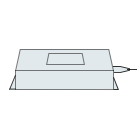
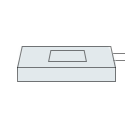
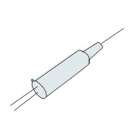
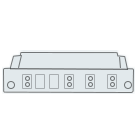
· Compact Size and Integration — Miniature in-line, receptacle, or free-space packages that fit inside QSFP-DD/OSFP form factors and co-packaged optics (CPO).
· Polarization Insensitivity — Critical for most transceiver applications.
· Broadband Operation — Covering C-band, O-band, or full C+L band as needed.
These requirements have driven innovation in isolator design, materials, and packaging specifically for 400G/800G ecosystems.
Applications in Modern Optical Networks
Optical isolators are now standard components across a wide range of high-speed applications:
· 400G and 800G pluggable optical modules
· AI-optimized data center interconnects
· Cloud computing infrastructure and hyperscale switch fabrics
· Coherent transmission systems (ZR, ZR+, LR)
· 5G/6G fronthaul and backhaul networks
· High-speed optical engines and silicon photonics solutions
· Test and measurement equipment for high-speed validation
Their presence directly contributes to higher port density, better power efficiency, and more reliable network operation.
GLSUN Optical Isolator Solutions
GLSUN has developed a comprehensive range of high-performance optical isolators specifically engineered for the stringent demands of 400G and 800G optical modules. Leveraging years of experience in optical communication technology and advanced manufacturing, GLSUN offers:
· Single-stage and dual-stage isolators with high isolation
· Ultra-low insertion loss designs
· Excellent thermal and environmental stability
· Compact packages optimized for pluggable modules and co-packaged optics
· High reliability and consistent mass-production quality
· Customization support for special wavelengths and power levels
With strict quality assurance processes, scalable production capacity, and full compliance with international standards, GLSUN serves global customers in telecom, data center, and AI networking markets.
The transition to 400G and 800G optical networks has introduced new levels of performance pressure on every optical component. In these high-speed environments, maintaining laser stability and minimizing signal interference are no longer optional—they are essential for meeting BER targets, power budgets, and reliability expectations.
Optical isolators provide the critical protection and stability required for reliable high-speed transmission. By effectively blocking harmful back reflections, they enable lasers to operate at their optimal performance, ensuring clean signals and robust network operation.
As AI, cloud computing, and digital infrastructure continue to accelerate network evolution, the importance of high-performance optical isolators will only grow. For module manufacturers and network operators aiming for successful 400G/800G deployments and future 1.6T systems, selecting the right isolator technology is a key factor in achieving competitive performance and long-term reliability.


