











Fiber Optic Tech
Why Optical Isolators Are Critical for AI Data Centers and 800G/1.6T Optical Modules
Artificial Intelligence (AI) is reshaping industries, economies, and daily life at an astonishing speed. The surge in large language models (LLMs), generative AI applications, cloud computing, and high-performance computing (HPC) has created unprecedented demand for data processing and storage. At the heart of this revolution are massive AI training clusters, where thousands—or even tens of thousands—of GPUs and accelerators exchange petabytes of data in real time. This east-west traffic places extreme pressure on networking infrastructure, demanding ultra-high bandwidth, ultra-low latency, and near-perfect reliability.
Optical interconnect technology has emerged as the indispensable backbone of modern AI data centers. Traditional copper-based solutions have reached their practical limits in terms of distance, power efficiency, and signal integrity at multi-hundred-gigabit speeds. As a result, optical modules have rapidly evolved: 400G deployments are now mainstream, 800G solutions are scaling aggressively, and 1.6T optical modules are transitioning from development to commercialization. Technologies like Silicon Photonics and Co-Packaged Optics (CPO) are further pushing the boundaries of density and efficiency.
In this high-stakes environment, even the smallest passive optical components can determine the difference between seamless performance and costly downtime. One such critical component is the optical isolator. Often inconspicuous, these devices play a pivotal role in protecting laser sources, maintaining signal integrity, and ensuring the long-term reliability of high-speed optical links. As data centers scale to support ever-more demanding AI work""s, optical isolators have transitioned from “nice-to-have” to essential building blocks.
AI Infrastructure: Fueling a New Era of Optical Networking
AI work""s differ fundamentally from traditional data center traffic. Instead of primarily north-south client-server communication, AI clusters generate massive volumes of east-west traffic between GPUs, switches, storage systems, and specialized accelerators. Training a single large model can involve continuous, synchronized data exchanges across thousands of nodes, requiring not just raw bandwidth but also deterministic low latency and 99.999%+ uptime.
Copper interconnects, while cost-effective for very short reaches, struggle with signal degradation, higher power consumption, and electromagnetic interference at speeds beyond 100G. Optical fiber, by contrast, offers superior bandwidth-distance product, lower power per bit, and immunity to EMI—making it the clear choice for modern hyperscale AI facilities.
Today’s leading AI data centers are rapidly adopting:
· 800G Ethernet for intra-rack and inter-rack connectivity.
· 1.6T Optical Modules to handle exploding aggregate bandwidth needs.
· Silicon Photonics for integrated, high-density solutions.
· Co-Packaged Optics (CPO) to minimize electrical-optical conversion distances and reduce power.
· High-density optical switches and advanced fiber management systems.
All these technologies depend on stable, high-quality laser sources. Any degradation in laser performance can cascade into system-wide issues, amplifying the importance of robust laser protection mechanisms like optical isolators. Market projections underscore this urgency. The optical interconnect market in AI data centers is experiencing explosive growth, with estimates showing significant expansion through 2030 and beyond, driven by the shift to higher-speed pluggable and integrated optics.
The Critical Need for Laser Stability in High-Speed Optical Modules
At the core of every optical transceiver lies one or more semiconductor lasers—DFB (Distributed Feedback), EML (Electro-absorption Modulated Laser), or VCSEL (Vertical-Cavity Surface-Emitting Laser)—that convert electrical signals into precise optical pulses. These lasers must maintain tight specifications: consistent output power, minimal wavelength drift, low noise, and stable operation across temperature and lifetime variations. However, semiconductor lasers are inherently sensitive to optical feedback—back-reflected light that re-enters the laser cavity.
Sources of back reflections are numerous in complex optical systems:
· Fiber connectors and mating interfaces.
· Fiber end faces (even with angled physical contact, or APC, connectors).
· Lenses, waveguides, and silicon photonic integrated circuits.
· Optical coatings, filters, and internal module interfaces.
· Photodetectors and other downstream components.
When reflected light returns to the laser, it can trigger a host of detrimental effects:
· Fluctuations in output power and wavelength instability.
· Increased Relative Intensity Noise (RIN).
· Phase noise and mode hopping.
· Degraded extinction ratio.
· Elevated Bit Error Rates (BER) in the link.
· Accelerated laser aging and premature failure.
In 800G and 1.6T systems using advanced modulation formats like PAM4 at 112G or 224G per lane, the tolerance for such imperfections shrinks dramatically. Even minor increases in noise or jitter can close the link budget margin, leading to retransmissions, reduced throughput, or complete link failures—unacceptable in always-on AI training environments where interrupting a job can waste enormous computational resources and energy.
Optical Isolators: The Essential One-Way Gate for Light
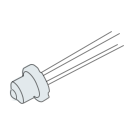
An optical isolator serves as the primary defense against these issues. It is a passive, non-reciprocal device that permits light to propagate in the forward direction with minimal loss while strongly attenuating light traveling backward. Its operation relies on the Faraday Effect: a magneto-optic phenomenon where the polarization plane of light rotates as it passes through a magneto-optic crystal (such as YIG or TGG) under a magnetic field. This rotation is independent of the light’s propagation direction. Combined with input and output polarizers, the isolator effectively blocks reverse-propagating light.
Typical performance metrics include:
· High isolation (often >30–60 dB for single- or dual-stage designs).
· Low insertion loss (ideally <0.5–1 dB).
· Broad operating wavelength range (e.g., 1310 nm or 1550 nm windows).
· Compact packaging suitable for pluggable modules or integrated photonics.
By preventing back reflections from reaching the laser, isolators stabilize its operation, reduce noise, and extend device lifetime.
Heightened Importance at 800G, 1.6T, and Beyond
As speeds increase, system margins tighten across every dimension. Higher-order modulation schemes demand exceptionally clean signals. At 800G and 1.6T, even small reflections that might have been tolerable at 400G can now degrade eye diagrams, increase error floors, or force more aggressive forward error correction (FEC) overhead, reducing effective pay"".
· Key requirements for next-generation isolators include:
· Ultra-low noise contribution to support sensitive receivers.
· Minimal insertion loss to preserve precious optical power budget.
· Excellent environmental stability for 24/7 operation in large-scale deployments.
· Compact form factors compatible with high-density modules and CPO designs.
· High reliability with extended mean time between failures (MTBF).
Without effective isolation, achieving the stringent performance and reliability targets of AI infrastructure becomes significantly more challenging and expensive.
Key Benefits in AI Data Centers
· Deploying high-quality optical isolators delivers tangible advantages:
· Laser Source Protection — Dramatically reduces feedback-induced degradation, extending laser lifespan and improving consistency.
· Superior Signal Quality — Lower jitter, reduced RIN, and more stable wavelength translate to better transmission performance.
· Lower Bit Error Rates — Cleaner signals improve link margins and overall network reliability.
· Enhanced System Uptime — Fewer module failures mean more stable AI clusters and reduced risk of expensive training interruptions.
· Reduced Total Cost of Ownership (TCO) — Lower maintenance, fewer replacements, and minimized downtime contribute to better operational efficiency.
In hyperscale environments where even brief outages carry massive costs, these benefits compound significantly.
Broader Applications Across Photonics
While AI data centers represent a high-growth segment, optical isolators are vital in numerous other fields:
· Fiber Lasers — Preventing destabilizing reflections in high-power systems used for materials processing and medical applications.
· EDFA and Optical Amplifiers — Suppressing backward ASE and reflections to maintain gain stability.
· Silicon Photonics — Protecting integrated lasers in compact PICs.
· LiDAR and Sensing — Ensuring stable emission for accurate distance measurement and imaging.
· Precision Instruments — Enhancing performance in optical coherence tomography (OCT), spectroscopy, and interferometry.
· Quantum Technologies — Minimizing feedback for stable single-photon sources in quantum communication and computing.
Selecting the Optimal Optical Isolator
Key parameters to uate include:
· Operating wavelength and bandwidth.
· Isolation level and isolation directionality.
· Insertion loss and polarization-dependent loss (PDL).
· Power handling capability.
· Package size and integration options (fiber pigtail, free-space, or inline).
· Fiber type compatibility (SMF, PMF, etc.).
· Temperature range and long-term reliability under vibration, humidity, and thermal cycling.
For AI modules, priorities often center on compactness, low loss, and proven field reliability. Industrial or scientific applications may emphasize higher power handling or specific polarization control.
GLSUN Optical Isolator Solutions
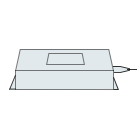
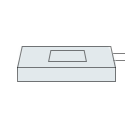
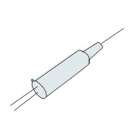
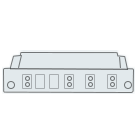
GLSUN offers a robust portfolio of optical isolator products engineered to meet the stringent demands of modern photonic systems. Options include single-stage and dual-stage designs, polarization-dependent and independent variants, fiber optic and free-space configurations. These solutions emphasize low insertion loss, high isolation, compact footprints, and exceptional long-term reliability—qualities that make them well-suited for AI data centers, high-speed optical modules, fiber lasers, amplifiers, silicon photonics, and advanced research applications. Backed by deep manufacturing expertise and rigorous quality processes, GLSUN components help system designers achieve the performance and stability required for next-generation infrastructure.
Conclusion
The AI era is defined by relentless scaling of compute, data movement, and networking performance. As the industry moves decisively toward 800G, 1.6T, and future terabit-class optical interconnects, every element in the signal chain must perform at its peak. Optical isolators, though small and passive, are indispensable guardians of laser stability in this demanding landscape. By effectively suppressing back reflections, they safeguard lasers, preserve signal integrity, reduce errors, and enhance overall system longevity. In doing so, they help enable the reliable, high-speed optical connectivity that powers today’s most advanced AI clusters and tomorrow’s intelligent computing infrastructure. As hyperscale data centers continue their rapid expansion, the demand for high-performance optical isolators will grow in tandem—solidifying their position as a foundational technology in the photonics ecosystem that underpins the AI revolution. Investing in quality isolators is not just a technical choice; it is a strategic enabler for sustained AI progress.


