









Fiber Optic Tech
Understanding the Faraday Effect: How Magneto-Optical Crystals Enable Optical Isolation
As laser technology advances toward higher power, greater precision, and improved stability, preventing reflected light from interfering with laser systems has become a critical consideration in optical system design. Optical isolators play an essential role in addressing this challenge. At the heart of an optical isolator is a magneto-optical crystal, the key material responsible for enabling non-reciprocal light transmission. Among the most important materials are TGG (Terbium Gallium Garnet) and TSAG (Terbium Scandium Aluminum Garnet), both of which offer valuable magneto-optical properties for Faraday rotators and high-performance optical isolators. But how does an optical isolator achieve one-way light transmission? What role does the Faraday Effect play? And why are TGG and TSAG considered important magneto-optical materials? This article explores the fundamental principles of the Faraday Effect, the operating mechanism of optical isolators, and the material properties that make TGG and TSAG valuable for advanced photonic applications.
1. What Is the Faraday Effect?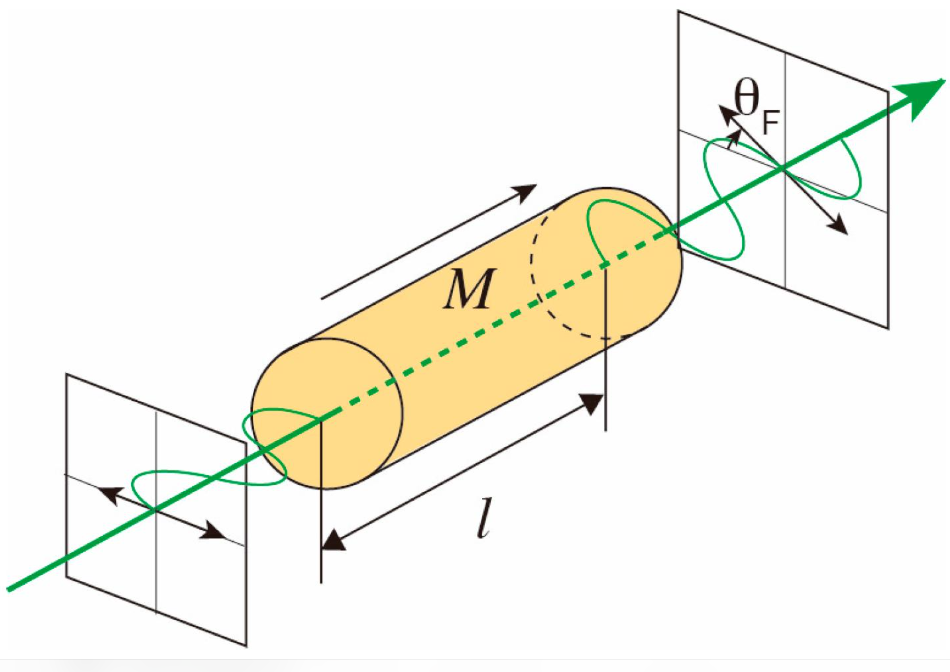
The Faraday Effect is a fundamental magneto-optical phenomenon discovered by British scientist Michael Faraday in 1845. It occurs when linearly polarized light passes through a transparent material subjected to an external magnetic field parallel to the direction of light propagation. The polarization plane of the transmitted light rotates as a result. This phenomenon is known as Faraday rotation. Unlike ordinary optical rotation, Faraday rotation has a particularly important characteristic: non-reciprocit. This means that when light travels backward through the same magneto-optical material, its polarization rotation remains in the same direction relative to a fixed laboratory reference frame, rather than reversing and canceling the original rotation. This unique property makes the Faraday Effect the physical foundation of optical isolation.
1.1 The Fundamental Principle of Faraday Rotation
When linearly polarized light enters a magneto-optical crystal, the external magnetic field affects the refractive indices experienced by its two circularly polarized components. As these components propagate through the crystal, they accumulate different phase shifts. When they recombine, the resulting linearly polarized light has a rotated polarization plane. The Faraday rotation angle can generally be expressed as:
θ = VBL
Where:
- θ: Faraday rotation angle (rad)
- V: Verdet constant, representing the magneto-optical rotation capability of the material
- B: Magnetic flux density along the direction of light propagation (T)
- L: Effective length of the magneto-optical crystal (m)
As the equation shows, Faraday rotation depends primarily on three factors: the Verdet constant, magnetic field strength, and crystal length.
Among these parameters, the Verdet constant is particularly important when uating magneto-optical materials. Under the same wavelength, magnetic field strength, and crystal length, a higher Verdet constant produces a greater polarization rotation angle.
1.2 Why Is the Faraday Effect Non-Reciprocal?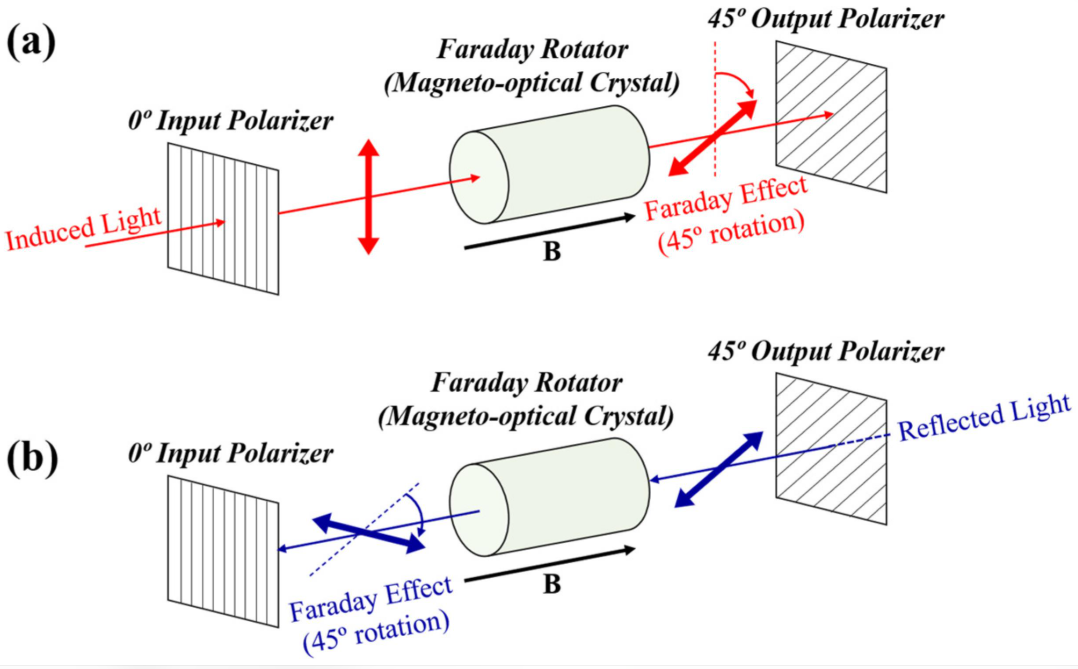
The defining characteristic of the Faraday Effect is that the direction of polarization rotation does not reverse when the direction of light propagation is reversed, when viewed in a fixed laboratory reference frame.
For example:
- Forward propagation: Light passes through a magneto-optical crystal, and its polarization rotates clockwise by 45°.
- Backward propagation: When light travels back through the same crystal, its polarization continues to rotate clockwise by 45°.
Therefore, the total polarization rotation during a round trip becomes 90°, rather than canceling out.
This non-reciprocal behavior allows magneto-optical crystals to work with polarization components to control forward and backward light transmission, making optical isolation possible.
2. How Does an Optical Isolator Use the Faraday Effect?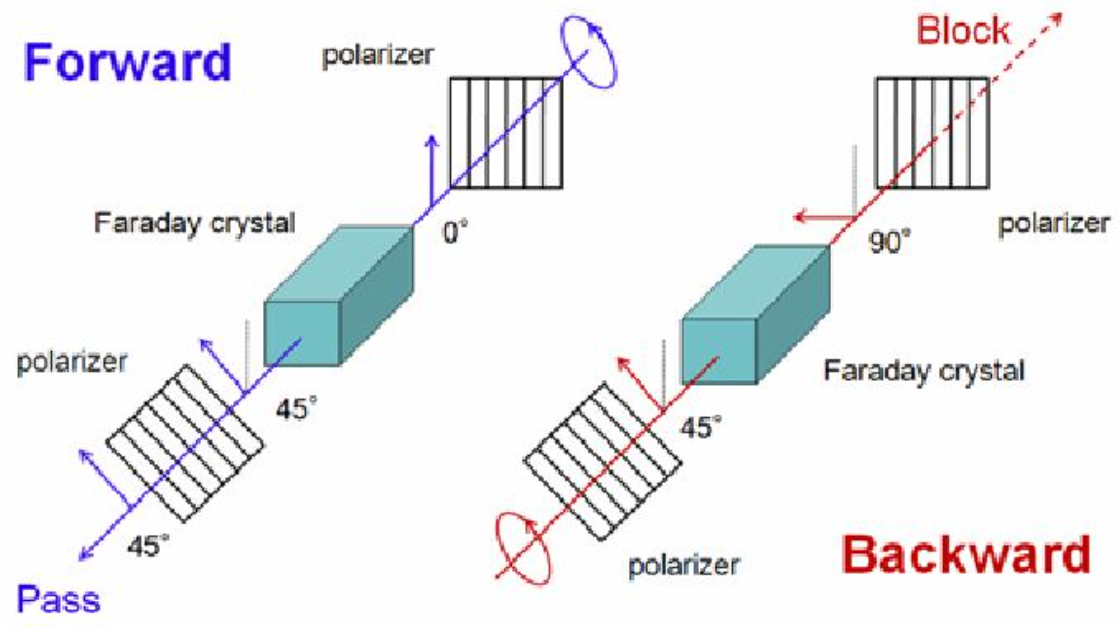
An optical isolator is a non-reciprocal optical device that allows light to travel in one direction while suppressing transmission in the opposite direction. It is widely used in laser systems, fiber-optic communication networks, optical amplifiers, and precision optical equipment. Its primary function is to prevent reflected light from returning to the light source, thereby protecting laser performance and system stability.
A typical free-space Faraday optical isolator consists of three main components:
1. Input Polarizer
2. Faraday Rotator
3. Output Polarizer (Analyzer)
The Faraday rotator generally consists of a magneto-optical crystal combined with permanent magnets that provide an axial magnetic field.
2.1 Forward Transmission: Allowing Light to Pass
When incoming linearly polarized light enters the optical isolator, it first passes through the input polarizer, which establishes a specific polarization direction. The light then enters the magneto-optical crystal within the Faraday rotator. Through the Faraday Effect, its polarization direction rotates by 45°. The rotated light subsequently reaches the output polarizer. Since the transmission axis of the output polarizer is oriented 45° relative to the input polarizer, the forward-propagating light can pass through successfully.
2.2 Backward Isolation: Blocking Reflected Light
When reflected light enters the optical isolator from the opposite direction, the process is different. The backward-propagating light first passes through the output polarizer and then enters the Faraday rotator. Due to the non-reciprocal nature of the Faraday Effect, its polarization continues to rotate in the same direction relative to the fixed reference frame. As a result, the polarization direction of the backward light becomes perpendicular to the transmission axis of the input polarizer, creating a total 90° relative rotation. When the light reaches the input polarizer, its polarization is orthogonal to the transmission axis. Consequently, the reflected light is strongly attenuated or blocked.
Operating Principle of a Faraday Optical Isolator
Forward Transmission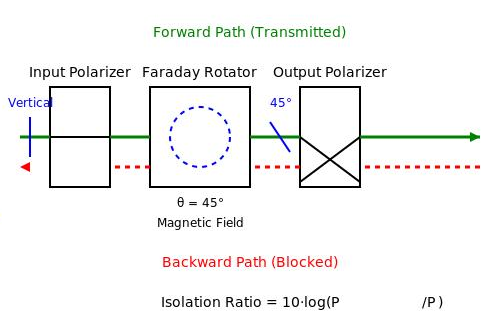
Light Source → Output
45° polarization rotation allows light to pass.
Backward Isolation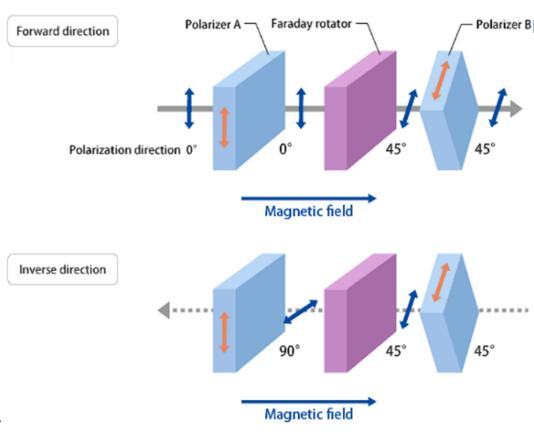
Reflected Light → Blocked
A total 90° relative rotation blocks backward light.
Through this mechanism, optical isolators achieve one-way light transmission, effectively reducing the impact of reflected light on lasers and other optical components.
3. TGG and TSAG: Key Materials for High-Performance Optical Isolation
In Faraday rotators, magneto-optical crystals directly determine rotation capability, optical loss, and thermal stability. They are therefore among the most important factors affecting overall optical isolator performance. TGG and TSAG are two important garnet-structured magneto-optical materials with applications in optical isolators and other magneto-optical devices.
3.1 TGG: A Mature and Reliable Magneto-Optical Material
TGG (Terbium Gallium Garnet) is one of the most established magneto-optical crystal materials currently used in optical devices.
Its main advantages include:
- High Verdet Constant: Provides strong Faraday rotation capability.
- Low Optical Absorption: Helps minimize transmission losses and internal heat accumulation.
- Good Thermal Properties: Supports stable operation under high-power conditions.
- Mature Processing Technology: Benefits from established crystal growth, precision processing, and device manufacturing experience.
TGG is widely used in Faraday rotators, optical isolators, and high-power laser systems, making it an important material for magneto-optical devices.
3.2 TSAG: An Advanced Material with Higher Magneto-Optical Potential
TSAG (Terbium Scandium Aluminum Garnet) is an emerging magneto-optical crystal with significant development potential. Compared with conventional TGG, one of its most notable characteristics is its potentially higher Verdet constant. Under the same magnetic field strength and crystal length, a higher Verdet constant produces a greater Faraday rotation angle. This creates new opportunities for optimizing Faraday rotator structures, reducing crystal length, and developing compact magneto-optical devices.
Its key characteristics include:
- Higher Verdet constant and improved magneto-optical rotation potential.
- Potential to reduce crystal length for a required rotation angle.
- An alternative material for high-performance, compact magneto-optical devices.
- Promising applications in high-power lasers and advanced optical systems.
However, practical TSAG performance must also be uated in terms of optical absorption, thermal properties, crystal homogeneity, and manufacturing processes.
3.3 TGG vs. TSAG: How to Choose the Right Material?
Both materials offer distinct advantages. The appropriate choice depends on device design and specific application requirements.
| Comparison | TGG | TSAG |
| Verdet Constant | High | Generally higher |
| Faraday Rotation | Excellent | Higher potential |
| Optical Absorption | Low | Depends on crystal quality |
| Thermal Properties | Good | Requires application-specific uation |
| Manufacturing Maturity | Relatively mature | Under continued development |
| Main Application Positioning | Established magneto-optical devices | Advanced magneto-optical device development |
For established optical isolator designs, TGG offers a mature and reliable material and manufacturing foundation. For applications seeking higher magneto-optical rotation efficiency and more compact device structures, TSAG provides an alternative technical direction. Rather than being direct substitutes, the two materials can complement each other across different application requirements.
4. Major Applications of Magneto-Optical Crystals
As laser technology continues to expand across industrial manufacturing, scientific research, and advanced optical systems, the demand for magneto-optical crystals is also growing.
4.1 High-Power Fiber Lasers
High-power fiber lasers require effective optical isolation to maintain stable operation.
Faraday isolators prevent reflected light from returning to the laser source, reducing potential interference with laser output and improving system reliability. TGG and TSAG crystals can serve as core rotation materials in these isolators, supporting optical isolation in high-power laser applications.
4.2 Solid-State Lasers
In solid-state laser oscillators and amplifier systems, optical isolators help minimize interference caused by reflected light, contributing to stable laser operation.
4.3 Fiber Amplifiers and Optical Communication Systems
In fiber amplifiers and related optical transmission systems, optical isolators suppress backward-propagating light and reduce the impact of reflections on optical amplification processes.
4.4 Precision Optics and Scientific Instruments
In laser measurement systems, optical experiments, and precision scientific equipment, magneto-optical crystals are used to build non-reciprocal optical systems for polarization control and optical isolation.
5. Future Trends in Magneto-Optical Crystals: Higher Performance and Broader Applications
As laser systems continue to evolve toward higher power, greater stability, and more compact designs, magneto-optical crystals face increasingly demanding performance requirements.
Future developments are expected to focus on several key areas:
- Higher Verdet Constants: Improving Faraday rotation efficiency and enabling optimized device designs.
- Lower Optical Absorption: Reducing optical losses and heat accumulation to improve device performance.
- Enhanced Thermal Properties: Minimizing thermally induced effects under high-power operation and improving system stability.
- Higher Crystal Quality: Optimizing crystal growth and processing to improve optical homogeneity and product consistency.
- Advanced Industrialization: Moving high-performance magneto-optical crystals from material research toward scalable manufacturing and commercial applications.
Throughout this development, TGG will continue to benefit from its established material advantages, while TSAG and other advanced magneto-optical crystals may create new opportunities for next-generation high-performance optical isolators.
6. GLSUN: Advancing the Industrialization of TGG/TSAG Magneto-Optical Crystals
As an important part of its full-chain optoelectronics strategy, GLSUN continues to advance the industrialization of TGG/TSAG magneto-optical crystals, focusing on foundational optoelectronic materials, core optical components, and photonic integration technologies. Guided by its strategic framework of “Materials Platform + Chip Manufacturing + Device Integration,” GLSUN is committed to building industrialization capabilities spanning foundational materials to core optical devices. Driven by growing demand for high-power lasers, fiber lasers, and advanced optical systems, GLSUN continues to focus on magneto-optical material optimization, process improvement, and application development, providing material and device support for diverse optical applications.
Conclusion
The Faraday Effect is a fundamental physical principle behind modern optical isolation technology, while magneto-optical crystals are the essential materials that make this technology possible. From the established reliability of TGG to the higher magneto-optical rotation potential of TSAG, continuous innovation in magneto-optical materials is driving Faraday rotators and optical isolators toward higher performance, lower optical loss, and more compact designs. As high-power lasers and advanced optical systems continue to evolve, magneto-optical crystals will play an increasingly important role in the future of the optoelectronics industry.


