

















Fiber Optic Tech
The Rise of Optical Circuit Switching (OCS)
As AI processing demands, large-scale cloud computing, and massive data analytics continue to explode, modern data centers are hitting fundamental limits. Virtualization and software-defined networking once delivered major efficiency gains, but today's reality is dominated by "stranded resources"—expensive GPUs, CPUs, and memory modules sitting idle because rigid hardware configurations prevent them from being quickly reassigned to the most urgent tasks.
The industry is converging on a clear path forward: full component disaggregation. This means decoupling compute (CPUs/GPUs), accelerators, and memory into independent, addressable resource pools that can be dynamically assembled into virtual nodes tailored to each work"". Achieving this vision, however, requires overcoming a major roadblock: traditional packet-based electrical switches.
Why Conventional Switches Are the Bottleneck
Traditional network switches struggle in a disaggregated world for several key reasons:
O-E-O Conversion Latency — Optical signals must be converted to electrical for switching and processing, then converted back to optical. This round-trip adds tens to hundreds of nanoseconds of delay—unacceptable for latency-sensitive GPU clusters or pooled memory access.
Protocol and Software Overhead — Ethernet/IP routing, packet processing, and control-plane software introduce delays incompatible with native high-speed protocols like PCIe, CXL, or InfiniBand.
Static Connectivity — Once cabled, resources are locked into fixed topologies, making real-time real impossible and leading to chronic underutilization.
The Breakthrough: GLSUN Optical Circuit Switches (OCS)
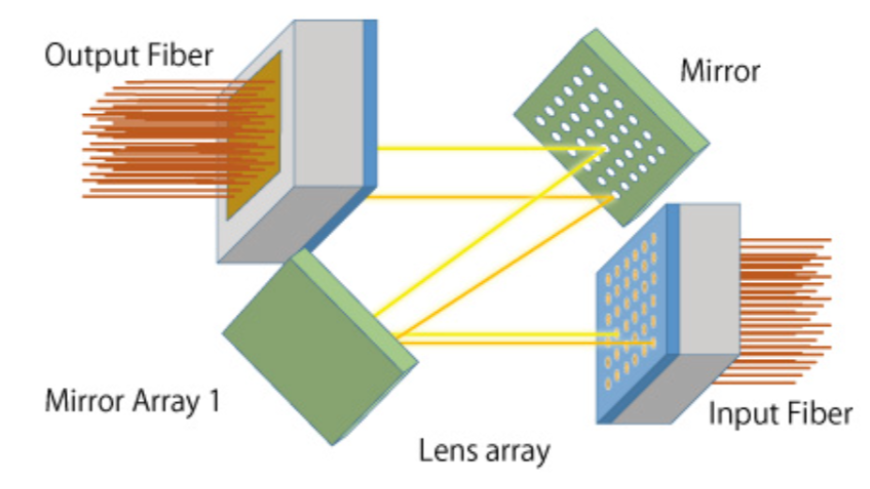
GLSUN's Optical Circuit Switch (OCS) solves these issues by shifting switching entirely to the optical domain using 3D MEMS mirror arrays. Instead of processing data packets, the OCS simply redirects light beams at near-instantaneous speeds.
Key advantages include:
Pure Optical Path — No electrical conversion (zero O-E-O latency), delivering performance close to direct fiber connections.
Millisecond Reconfiguration — Software-controlled mirror tilting enables topology changes in milliseconds, with the flexibility of a manual patch panel but fully automated.
Protocol-Agnostic Transparency — The switch is completely transparent and supports native PCIe, InfiniBand, Ethernet, and other interfaces without modification.
In essence, OCS acts as a high-speed, software-defined optical cross-connect—allowing administrators to "move the light, not the fiber."
Introducing V-Cluster: Fluid Resource Pools for the AI Era
GLSUN OCS powers the "V-Cluster" architecture, where every component—GPU, CPU, memory bank—becomes part of a shared, dynamically allocatable pool. Through optical cross-connections, physically distributed resources are virtually "welded" together to form high-performance, unified nodes.
|
Feature |
Traditional Fixed Server Model |
GLSUN OCS V-Cluster Model |
|
Resource Al |
Static, hardware-bound |
Dynamic, on-demand pooling |
|
Connectivity |
Fixed cabling, hard to change |
Software-defined, millisecond reconfiguration |
|
Latency |
Higher due to O-E-O and protocol stack |
Near-zero added latency (optical-speed switching) |
|
Supported Protocols |
Limited by Ethernet/IP overhead |
Native PCIe, CXL, InfiniBand, etc. |
|
Utilization Rate |
Frequent stranded capacity |
Significantly higher, reduced waste |
Real-World Agility: Lightning-Fast Adaptation
With OCS-enabled V-Clusters, data centers gain unprecedented flexibility:
· Instantly assemble thousands of idle GPUs into massive AI training clusters during peak demand.
· Dynamically expand memory pools for in-memory s without data migration.
· Rapidly reconfigure CPU or storage resources to match shifting application needs—all in milliseconds, remotely, and without manual intervention.
This level of agility dramatically improves resource efficiency, cuts power consumption (often 30–40% in networking layers), and lays the foundation for future co-packaged optics (CPO) and advanced optical interconnects.
The Bottom Line: Light-Speed Is the New Standard
In an era where compute demand grows exponentially, the real constraint has shifted from raw processing power to connectivity and scheduling agility. GLSUN's Optical Circuit Switching eliminates electrical backplane bottlenecks, ends stranded resource waste, and enables truly software-defined, light-speed infrastructure. The age of static data centers is ending. The future belongs to architectures that reconfigure at the speed of light.


