




















Fiber Optic Tech
Optical Circuit Switching is Accelerating the Next Generation of Intelligent Optical Networks
Optical Circuit Switching (OCS) marks a profound strategic shift in optical networking, evolving from basic point-to-point "connection" capabilities to sophisticated, intelligent "switching" functions. As data centers and AI clusters face escalating demands for bandwidth and energy efficiency, OCS emerges as a transformative solution capable of addressing the critical bottlenecks of traditional electrical switching architectures. By enabling all-optical signal routing, OCS is rapidly becoming a fiercely contested arena where leading optical technology vendors are racing to innovate and deploy next-generation solutions.
Understanding Optical Circuit Switching (OCS)
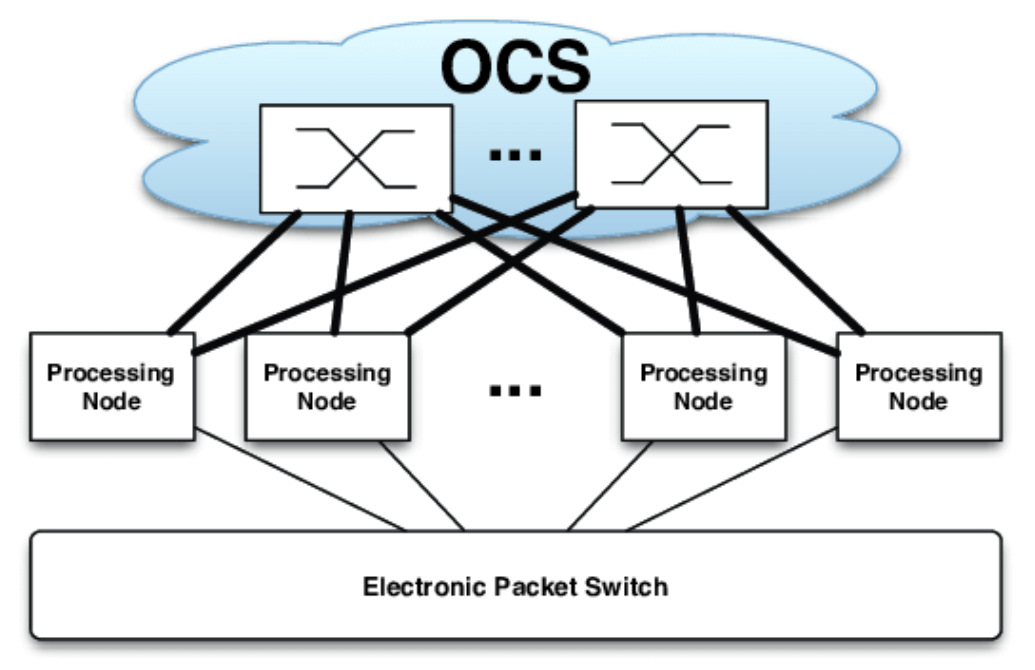
At its core, Optical Circuit Switching (OCS) is an all-optical switching technology that establishes and maintains dedicated optical paths across network nodes. Unlike conventional electronic switches, which rely on repeated Optical-Electrical-Optical (OEO) conversions, OCS performs routing entirely within the optical domain through physical reflection or redirection of light signals.
The fundamental mechanism involves dynamically reconstructing physical transmission paths between fiber ports. When an optical signal enters the switch, it is redirected via an internal optical switching matrix to create a direct, end-to-end optical circuit between any input and output port. This eliminates the power-hungry and latency-inducing OEO conversions that characterize traditional switching equipment. By keeping data in the optical realm for as long as possible, OCS achieves unprecedented efficiency in large-scale, high-performance environments.
Key Characteristics of Optical Circuit Switching
OCS brings several defining features that distinguish it from legacy technologies:
Direct Optical Path Switching: Signals traverse the switch without electrical conversion, leveraging technologies like Wavelength-Division Multiplexing (WDM) and advanced cross-connection mechanisms.
Simplified Architecture: Optical-electrical conversion is pushed to the endpoint servers or compute nodes, dramatically reducing the complexity and component count inside the switch itself.
Significantly Lower Cost and Power Consumption: When combined with innovative network topologies such as 3D ring architectures, OCS substantially cuts both capital expenditure on hardware and operational energy costs compared to traditional electrical switches.
These characteristics make OCS particularly attractive for hyperscale data centers and AI training clusters, where massive interconnectivity and power efficiency are paramount.
Major Advantages of Optical Circuit SwitchingThe benefits of adopting OCS extend across multiple dimensions of network performance:
Ultra-Low Latency and Cost Efficiency: By bypassing OEO conversions, OCS delivers minimal transmission delays while reducing the overall network infrastructure footprint and associated expenses.
Reduced Power Consumption and Hardware Requirements: The absence of optical-electrical conversions inside the switch leads to dramatically lower energy usage and decreases dependence on expensive optical modules, offering substantial savings at scale.
Minimal Insertion Loss with Superior Bandwidth Support: OCS maintains excellent signal integrity, supporting high-speed transmission with very low insertion loss, which ensures both high throughput and long-term operational stability.
Dynamic Reconfigurability and Operational Flexibility: Networks can rapidly adapt routing paths in response to changing work""s, making OCS ideal for unpredictable, bursty AI and HPC traffic patterns.
Protocol and Rate Transparency: OCS is completely agnostic to data formats, protocols, and transmission speeds. This allows seamless interconnection of heterogeneous computing nodes (such as TPUs and GPUs operating at different rates) within the same fabric. It also facilitates incremental upgrades and supports hardware reusability across technology generations.
Cluster-Optimized Deployment: Topologies like 3D rings simplify the design and scaling of massive AI superclusters, reducing cabling complexity and improving overall system manageability.
Technical Approaches to Optical Circuit SwitchingSeveral mature and emerging technologies power modern OCS implementations:
MEMS (Micro-Electro-Mechanical Systems): The most widely deployed solution today, MEMS uses arrays of microscopic mirrors etched on silicon substrates to redirect incoming light beams to desired output ports. It offers an excellent balance of cost, precision, reliability, and scalability, making it the dominant choice for current data center deployments.
Digital Liquid Crystal (DLC): This approach manipulates the refractive index of liquid crystal materials through external electric fields. DLC requires very low driving voltages (typically under 10V), delivering high reliability that makes it suitable for mission-critical applications such as submarine cable networks.
Direct Beam Steering (DBS): Utilizing piezoelectric ceramics, DBS physically adjusts collimators to achieve precise alignment between input and output arrays. While currently more expensive, its low power profile positions it favorably for future ultra-high-speed applications.
Silicon Optical Waveguide Solutions: An emerging frontier, exemplified by companies like iPronics, this technology integrates optical routing through silicon photonics waveguides. It promises exceptional density and integration potential, supporting both scale-up (within racks) and scale-out (across clusters) networking requirements.
While current large-scale deployments primarily rely on MEMS-based systems, the industry is steadily transitioning toward more integrated silicon-based optoelectronic OCS platforms that will deliver higher port counts and greater flexibility.
Impact on Optical Transceiver Vendors: Challenges and Opportunities
The proliferation of OCS is poised to significantly reshape the optical transceiver market. On one hand, the ability to dynamically reconfigure fiber connections may reduce the sheer volume of static point-to-point links, potentially pressuring vendors heavily focused on lower-speed or basic connectivity products. On the other hand, OCS deployment raises the performance bar for transceivers, demanding higher data rates (400G, 800G, and soon 1.6T), lower insertion loss, better thermal characteristics, and deeper integration with silicon photonics. This shift creates substantial opportunities for technology leaders capable of delivering cutting-edge modules tailored for AI and HPC environments. Ultimately, OCS does not threaten the transceiver industry — it catalyzes its evolution from a volume-driven market to one centered on high-performance innovation and value-added differentiation.
A Complementary Future for All-Optical Networks
Optical Circuit Switching represents a critical milestone on the journey toward fully all-optical networking. By overcoming the power and bandwidth limitations inherent in traditional electrical switching, OCS unlocks new levels of scalability and efficiency for the most demanding computing work""s. Rather than viewing OCS and optical transceivers as competing technologies, they should be seen as mutually reinforcing components of a next-generation ecosystem. As artificial intelligence, machine learning, and high-performance computing continue driving exponential growth in bandwidth and latency requirements, the synergy between intelligent optical switching and high-performance transceivers will be instrumental in building the efficient, powerful, and sustainable network infrastructures of tomorrow. The optical industry stands at an exciting inflection point, where OCS is not merely an incremental improvement, but a foundational technology enabling the next era of digital innovation.