

















Fiber Optic Tech
How to Choose an Optical Isolator Array: 1CH, 2CH, 4CH, and 8CH Explained
Optical isolators are critical passive components in high-speed optical communication systems. They suppress back-reflected light, protect laser sources (such as EML, DFB, or CW lasers in silicon photonics), reduce relative intensity noise (RIN), and enhance the stability and reliability of the entire optical link. In PAM4-modulated high-speed systems, where eye openings are smaller, reflected light-induced noise can more easily degrade signal quality—making isolators especially important.
As optical modules evolve from 100G and 200G to 400G, 800G, and 1.6T, the number of internal optical paths and the level of integration continue to increase. While conventional single-channel optical isolators remain flexible and mature, multi-channel array solutions are becoming increasingly essential for high-density parallel optical architectures. These arrays significantly reduce the number of discrete components, optimize packaging space, simplify assembly, and improve channel consistency. GLSUN offers a complete range of 1CH, 2CH, 4CH, and 8CH optical isolator array solutions. How should you choose the right configuration, and which applications best suit each one? Below is a detailed analysis covering principles, applications, and selection guidelines.
1. What Is an Optical Isolator Array?
An optical isolator utilizes the Faraday magneto-optic effect to allow light to pass primarily in one direction while strongly suppressing light traveling in the reverse direction. Its primary function is to reduce the impact of reflected optical power on lasers and other sensitive optical components, thereby ensuring long-term system stability.
An optical isolator array integrates multiple isolation channels into a single compact component:
· 1CH → 1 optical path
· 2CH → 2 optical paths
· 4CH → 4 optical paths
· 8CH → 8 optical paths
This array architecture is particularly well-suited for multi-channel parallel optical modules. Compared with using multiple discrete single-channel isolators, the array approach reduces component count, lowers assembly complexity, saves internal space, and enables more organized optical path layouts—facilitating high-density automated packaging. In AI data center-driven 800G/1.6T parallel optics (such as DR8 and PSM8 architectures), the number of channels multiplies, increasing isolator usage accordingly. Array integration has become an effective way to improve overall module integration density and reliability.
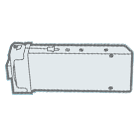
2. 1CH Optical Isolator: When Should You Choose a Single-Channel Solution?
Although multi-channel integration is a major trend, single-channel optical isolators remain widely used due to their flexibility, maturity, and independent layout advantages.
Typical applications include:
· Single-channel optical systems
· Laser protection (DFB/EML, etc.)
· Fiber lasers and optical amplifiers (EDFA, etc.)
· Optical sub-assemblies (TOSA/BOSA)
· Applications requiring flexible optical layouts or customized designs
· Medium- and low-speed systems or test instruments
When a system requires only one isolation path, a 1CH solution is the most straightforward, cost-effective, and proven choice. There is no need to adopt a multi-channel array solely for the sake of higher integration. In simple terms: one optical path → choose 1CH. GLSUN’s 1CH solutions deliver high isolation, low insertion loss, and excellent temperature stability to meet diverse requirements.
3. 2CH Optical Isolator: Balancing Flexibility and Integration
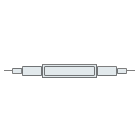
When an optical system contains two parallel optical paths, a 2CH array provides a natural and efficient solution. Instead of installing two independent single-channel isolators, a 2CH array integrates both channels into a single compact structure.
Key advantages include:
· Higher integration: Two channels in one component, reducing discrete devices and solder points.
· More compact packaging: Optimizes layouts in space-constrained optical modules.
· Simplified optical path management: Channels are arranged in a predefined structure, facilitating alignment and packaging.
Lower assembly costs and fewer potential failure points.
GLSUN’s 2CH optical isolator arrays are designed for compact high-speed optical module architectures, offering an effective balance between integration and design flexibility for dual-channel scenarios, including certain 200G/400G dual-channel or customized parallel structures.
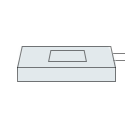
4. 4CH Optical Isolator: Ideal for Parallel Optics and 400G/800G Modules
As optical modules advance toward 400G and 800G, parallel optical transmission (such as DR4 and FR4) has become increasingly important. This is where 4CH optical isolator arrays are particularly relevant. In parallel optical modules, multiple optical paths must be coupled, isolated, and packaged within limited space. Using individual single-channel isolators for every path increases component count, complicates internal layouts, and raises assembly difficulty and cost. A 4CH array integrates four isolation paths into a single component, delivering a more compact and efficient high-density packaging solution.
Typical applications include:
· 400G optical modules (DR4, etc.)
· 800G optical modules (certain architectures)
· Parallel optical modules and data center interconnects (DCI)
· High-speed optical transceivers and optical sub-assemblies
· High-density fiber-array packaging
For applications requiring four parallel optical paths, a 4CH array provides an excellent balance of integration, packaging efficiency, and design flexibility, effectively supporting the miniaturization and high-reliability requirements of 400G/800G modules.
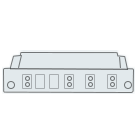
5. 8CH Optical Isolator: For Higher-Density Optical Interconnects
If 4CH represents high-density parallel optics, 8CH takes optical integration a step further—precisely matching the needs of AI data centers for higher bandwidth and denser architectures.
The explosive growth of AI computing power is driving the rapid development of 800G and 1.6T optical modules (such as DR8 and PSM8 architectures, which often require eight parallel optical paths). An 8CH array integrates more isolation channels into a single component.
Key advantages include:
· High channel integration: Eight channels in one component, significantly reducing discrete device count and space occupancy.
· Efficient use of package space: Compact structure suits highly space-constrained high-speed modules.
· Compatibility with parallel optics: Works seamlessly with fiber arrays, lens arrays, and other multi-channel components.
· Support for high-density automated packaging: Standardized array structure facilitates optical alignment and mass assembly, improving consistency and yield.
Lower overall system cost and fewer potential failure points.
GLSUN provides 8CH optical isolator array solutions designed for high-density optical modules and advanced optical interconnect applications, helping 800G/1.6T modules achieve higher integration and reliability.
6. How Should You Choose Between 1CH, 2CH, 4CH, and 8CH?
The simplest starting point is the number of optical paths and the required level of integration. However, channel count alone is not sufficient. A complete selection should also consider the following critical parameters:
| Configuration | Typical Applications | Key Characteristics |
|---|---|---|
| 1CH | Single-channel systems, laser protection, fiber lasers/amplifiers | Flexible, mature, independent optical layout |
| 2CH | Dual-channel optical modules | Higher integration with compact packaging, balanced flexibility |
| 4CH | 400G/800G parallel optical modules | High-density parallel optics, excellent packaging efficiency |
| 8CH | 800G/1.6T and higher-density optical modules | Higher channel integration, suited for AI data center high-density architectures |
Additional key uation dimensions:
· Insertion Loss — Lower is better; it directly affects the optical power budget. High-speed modules are sensitive to link budget, so low insertion loss helps maintain system margin.
· Isolation — A fundamental performance parameter. High isolation (typically ≥30 dB for single-stage, higher for dual-stage) effectively suppresses backward-propagating light and reduces impact on the laser source. This is especially critical in PAM4 systems.
· Channel-to-Channel Consistency — Particularly important for 4CH and 8CH arrays. Not only must individual channel performance be strong, but differences in insertion loss, isolation, etc., between channels must also be minimal to ensure uniform multi-channel system performance.
· Package Size and Structure — One of the main advantages of array integration is improved space utilization. Designers should consider the module’s internal space, fiber pitch, coupling structure, and arrangement of other optical components.
· Operating Wavelength and Optical Power Handling — Different applications require different wavelengths (commonly O-band around 1310 nm or C-band) and power levels; these must be confirmed to match the system design.
· Environmental Reliability — High-speed optical modules are expected to operate reliably over extended periods. Isolator arrays must deliver not only strong initial performance but also stable performance across temperature variations and long-term operating conditions, supported by relevant reliability testing.
uating these factors comprehensively ensures the most suitable solution for the system architecture.
7. How Do Optical Isolator Arrays Work Together with Fiber Arrays?
Optical isolator arrays do not operate in isolation. In high-speed optical modules, they typically work together with fiber arrays, lens arrays, TOSAs, ROSAs, and other optical sub-assemblies to complete the overall optical path. For example, a multi-channel fiber array provides precise fiber positioning and pitch control, while an optical isolator array delivers optical isolation for multiple parallel paths. Their combination enables efficient coupling and high-density packaging.
GLSUN also offers multiple fiber-array configurations, including MT-FA, MT-2FA, MT-4FA, 4CH Fiber Array, and 8CH Fiber Array solutions designed for high-speed optical modules and photonic packaging. The combination of optical isolator arrays + fiber arrays + advanced optical packaging effectively addresses the growing demand for higher density, smaller form factors, and improved reliability.
8. From 400G to 1.6T: Array Integration Is Becoming an Important Trend
The evolution of high-speed optical modules is fundamentally a process of increasing optical integration—from single-channel to multi-channel, and from discrete components to array-based solutions—to support higher bandwidth, smaller package sizes, and increasingly complex optical architectures.
Strong demand for 800G and 1.6T from AI data centers is driving the need for more efficient optical interconnects. For optical module manufacturers, integrating more optical paths into a limited package has become a key design challenge. As a result, the future development of optical isolator arrays will focus on:
· Higher channel counts
· Smaller package sizes
· Lower insertion loss
· Higher isolation
· Better channel-to-channel consistency
Improved compatibility with efficient automated packaging
At the same time, with the advancement of silicon photonics, co-packaged optics (CPO), and near-packaged optics (NPO), the value of highly integrated, high-reliability array devices will continue to grow.
9. GLSUN Optical Isolator Arrays: Flexible Solutions from 1CH to 8CH
To address the requirements of different optical modules and optical architectures, GLSUN provides a complete series of optical isolator array solutions from 1CH to 8CH:
· 1CH — Flexible single-channel optical isolation
· 2CH — Compact dual-channel integration
· 4CH — High-density parallel optical applications
· 8CH — Higher channel density for high-speed optical modules
Customers can the appropriate configuration based on optical path count, package space, optical architecture, and integration requirements. As 400G, 800G, and 1.6T optical modules continue to evolve, optical isolators are transitioning from conventional discrete functional components toward multi-channel, highly integrated, array-based optical solutions.
For next-generation optical modules, choosing the right optical isolator array is not simply about selecting a component—it is about optimizing the overall optical packaging architecture. From 1CH to 8CH, GLSUN delivers flexible, high-density optical isolation solutions for the evolving optical interconnect industry, helping customers achieve higher performance and more reliable system designs.


