















Fiber Optic Tech
A Comparison of ROADM Architectures: WB, PLC, WSS, and WXC
Reconfigurable Optical Add-Drop Multiplexers (ROADMs) are essential components in modern wavelength-division multiplexing (WDM) networks, enabling dynamic addition, dropping, and routing of wavelengths without needing to physically re-patch fibers. This flexibility has driven the evolution of optical transport networks, from metro rings to long-haul mesh architectures and increasingly to DCI (data center interconnect) and 5G fronthaul/backhaul applications.
Over time, ROADM designs have progressed through several generations, each based on different core switching technologies: Wavelength Blocker (WB), Planar Lightwave Circuit (PLC), Wavelength Selective Switch (WSS), and Wavelength Cross-Connect (WXC). These four types differ significantly in architecture, flexibility, node degree support, colorless/contentionless capability, cost, and typical deployment scenarios.
WB ROADM (Wavelength Block ROADM)
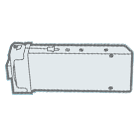
WB ROADM operates at the wavelength block level, switching groups of wavelengths together rather than individual channels. It is typically based on fixed optical filters and simple switching elements.
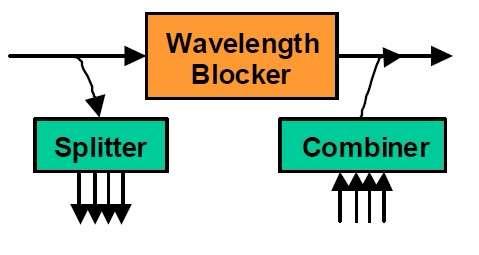
Key characteristics:
- Typically supports degree-2 (ring or linear) nodes.
- Express wavelengths pass through with selective blocking/attenuation.
- Add/drop ports are usually colored and directional (fixed wavelength per port).
- Often includes per-channel VOAs for power equalization.
Advantages:
- Relatively simple and low-cost for basic reconfigurability.
- Good for upgrading static OADMs in legacy long-haul or metro rings.
- Low insertion loss in express path.
Disadvantages:
- Very limited flexibility — add/drop wavelengths are fixed.
- No support for multi-degree nodes.
- No colorless or contentionless operation.
WB ROADMs are well suited for metro or access networks where traffic patterns are predictable and frequent reconfiguration is not required.
PLC ROADM (Planar Lightwave Circuit ROADM)
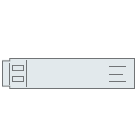
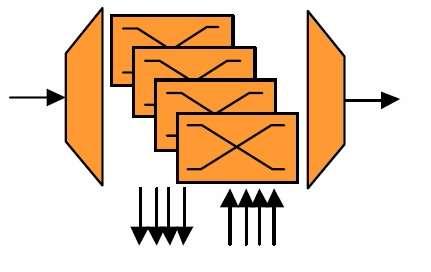
PLC-based ROADMs rely on integrated planar lightwave circuit technology to implement wavelength routing and add/drop functions. These devices are often semi-static, offering predefined optical paths.
Key characteristics:
- Best suited for degree-2 nodes (though some implementations reach degree-3).
- Add/drop ports are typically colored (fixed wavelength).
- Switching happens after demux → switch matrix → remux.
Advantages:
- Compact footprint (monolithic integration).
- Low power consumption in some polymer-based PLC designs.
- Excellent channel equalization and monitoring.
- Cost-effective for metro/access applications.
Disadvantages:
- Add/drop wavelengths are fixed → no wavelength reconfiguration without hardware changes.
- Scalability limited for higher-degree nodes.
- Insertion loss can be higher due to multiple mux/demux stages.
PLC ROADMs are commonly deployed in access and metro aggregation networks where network configurations remain largely unchanged over time.
WSS ROADM (Wavelength Selective Switch ROADM)
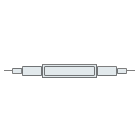
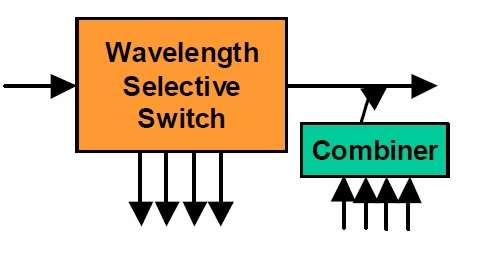
WSS-based ROADMs are the most widely adopted solution in modern optical networks. Using wavelength selective switches, they can dynamically route individual wavelengths to any direction.
Key characteristics:
- Supports degree 3–9+ nodes easily (multi-degree ROADM).
- Enables colorless, directionless, and often contentionless (CDC) add/drop when combined with proper architecture.
- Any wavelength can be routed to any express or add/drop port (gridless/contentionless variants available).
Advantages:
- High flexibility — dynamic wavelength assignment without pre-planning.
- Excellent for mesh, ring-to-mesh, and CDC ROADM architectures.
- Supports C+L band, super-channel, and flexible grid (50/37.5/25 GHz spacing).
- Per-channel power control and monitoring built-in.
- Scales well to high port counts (e.g., 1×43 WSS common in 2025–2026 designs).
Disadvantages:
- Higher cost per node than PLC or WB.
- Slightly higher insertion loss and polarization-dependent loss in some implementations.
- More complex control software needed.
WSS ROADMs are the preferred choice for core, metro core, and large-scale transport networks requiring frequent reconfiguration and high operational efficiency.
WXC (Wavelength Cross-Connect)
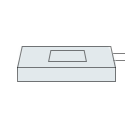
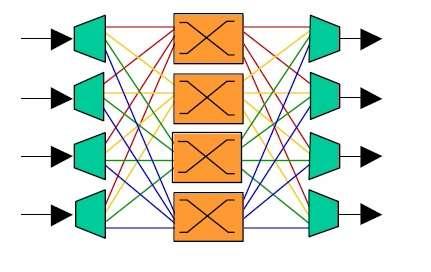
WXC represents the most advanced form of ROADM, providing full wavelength-level cross-connection between multiple fibers and directions. It is often implemented using multiple WSS modules or optical switch matrices.
Key characteristics:
- True N×N non-blocking connectivity for degree 5+ (often 8–16+ degree) mesh nodes.
- Full any-to-any wavelength routing across multiple fibers.
- Supports CDC and gridless operation when using advanced WSS fabrics.
Advantages:
- Maximum flexibility for complex mesh topologies.
- No wavelength contention across directions.
- Ideal for large hub nodes in national/international backbones.
- Future-proof for very high-degree reconfigurable optical networks.
Disadvantages:
- Highest cost and power consumption.
- Larger footprint and more complex cabling.
- Higher insertion loss unless using low-loss large-port WSS.
WXC is typically deployed in national backbone and ultra-large core networks, where maximum flexibility, scalability, and survivability are required.
Comparative Summary
| ROADM Type | Granularity | Flexibility | Cost Level | Typical Network Layer |
| WB ROADM | Block-level | Low | Low | Access / Metro Edge |
| PLC ROADM | Fixed / Semi-static | Medium | Low–Medium | Access / Metro |
| WSS ROADM | Per-wavelength | High | Medium–High | Metro Core / Core |
| WXC | Any-to-any wavelength | Very High | High | Core / Backbone |
In summary, each ROADM type—WB, PLC, WSS, and WXC—serves a distinct role in optical network evolution. While WB and PLC ROADMs focus on cost efficiency and stability, WSS ROADMs and WXCs deliver the flexibility and scalability demanded by modern, high-capacity optical transport networks. Understanding these differences helps network operators the most suitable ROADM architecture to balance cost, performance, and future network growth. For the highest-degree mesh nodes, WXC fabrics provide the ultimate scalability — though at a premium. As optical networks continue evolving toward flexible grid and multi-band (C+L+S) operation, WSS and WXC technologies remain the foundation for agile, high-capacity optical transport.


